
Business Succession Planning: Building Legacy Through Employee Share Ownership
In today’s competitive business landscape, succession planning is no longer just about preparing for ownership transfer, it’s about building a lasting legacy. Many modern business owners now prioritise employee retention, loyalty, and continuity over short-term sale value. One of the most effective tools supporting this shift is the Employee Share Ownership Plan (ESOP) or Employee Share Scheme (ESS).
Why Employee Share Plans Are Gaining Momentum?
Employee share plans have grown rapidly, especially among SMEs and professional service firms such as accounting, engineering, and architecture practices.
The motivation behind these plans is changing. Rather than cashing out at retirement, many founders now aim to:
- Reward loyal employees who helped build the business.
- Secure leadership continuity.
- Strengthen company culture and performance.
When employees become partial owners, they start to think and act like business owners, improving productivity, innovation, and long-term profitability.
Understanding the Peak Performance Trust (PPT)
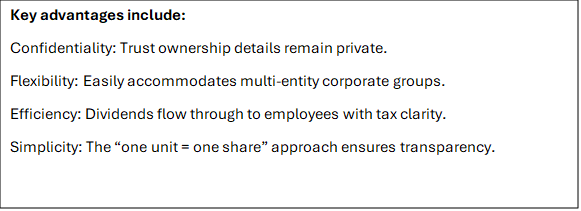
One of the most flexible models for SMEs is the Peak Performance Trust (PPT). This structure allows a business owner to establish a trust that holds company shares (or equity-linked units) on behalf of key employees.
Employees don’t hold direct shares, instead, they own units within the trust, avoiding the complexities of shareholder management.
How It Works: Funding and Eligibility
Participation is by invitation and often based on tenure or performance (for example, employees who’ve served at least 12 months or reached a management “rank”).
Funding can occur in several ways:
- Profit-share contributions from company profits (most common).
- Employee buy-ins using cash or salary sacrifice.
- Employer-gifted shares under Division 83A for tax deferral.
- External finance, such as employee loans from Macquarie Bank.
A popular approach is the profit-share model, where a percentage of profit above a threshold is contributed to the trust. This method ensures the plan is self-funding and rewards long-term growth rather than short-term bonuses.
Case Study Example
A medium-sized equipment hire company implemented a Peak Performance Trust as part of its succession strategy.
Before the Plan (Year 0):
- Company valuation: $28 million
- Annual revenue: $15 million
- Number of employees: 65
- Employee turnover: 18% per annum
- Ownership: 100% founder-held
The founder, aged 58, wanted to gradually step back while rewarding loyal staff and ensuring long-term sustainability. Instead of selling to a competitor, he introduced a PPT-based Employee Share Ownership Plan (ESOP) with an initial 3% employee equity pool funded through profit-sharing.
Implementation Details:
- Eligibility: Employees with 2+ years of service.
- Profit Benchmark: $2 million Net Profit After Tax (NPAT).
- Contribution Rule: 15% of profits above the benchmark contributed to the PPT.
- Allocation Formula: Based on a mix of salary, performance score, and years of service.
- Annual Independent Valuation: To determine unit value.
Year 1–3 Results:
- NPAT increased from $2.1 million to $3.8 million (+81%).
- 14 employees qualified for participation.
- $120,000 contributed to the trust each year, used to purchase equity units.
- Employee turnover dropped from 18% to 9%.
- Productivity (measured as revenue per employee) rose by 22%.
Year 4–6 Results:
- Valuation rose from $28 million to $62 million (+123%).
- Employee ownership increased from 0.86% to 3%, worth roughly $3.5 million collectively.
- The founder successfully transitioned 20% of management control to senior staff, ensuring a smooth succession.
- Employee satisfaction scores increased by 35%, and absenteeism fell by 17%.
Key Outcome:
By linking ownership with performance, the company achieved both financial growth and cultural transformation. Employees began treating equipment maintenance, client relationships, and safety as personal investments in their future.
Tax and Compliance Benefits
The Peak Performance Trust offers several tax advantages:
- Employer contributions are deductible and exempt from Fringe Benefits Tax (FBT).
- The trust receives funds as capital, not income.
- Employees benefit from tax deferral of up to 15 years under Division 83A, giving them time to build value before facing any tax event.
This makes it a cost-effective way to transition ownership while maintaining alignment between business and employee interests.
Best-Practice Guidelines
For successful implementation, advisors recommend:
- Keep it simple and measurable. Avoid overly complex formulas.
- Start small. Offer 2–3% ownership initially, then expand annually.
- Tailor the trust deed. Avoid generic templates; match the plan to business objectives.
- Review annually. Reassess performance metrics, valuations, and employee engagement.
- Educate employees. Understanding equity benefits is key to long-term success.
Why Employee Ownership Strengthens Succession
Employee share ownership creates a win-win scenario:
- For owners: Provides an exit path that preserves culture, leadership, and value.
- For employees: Delivers financial rewards and a sense of ownership.
- For the business: Improves retention, productivity, and long-term stability.
How Growth Guardian Supports Your Succession Journey
At Growth Guardian, we help business owners design and implement effective succession and employee ownership strategies that protect their legacy and empower their teams. From structuring trusts and tax-efficient share schemes to ensuring ongoing compliance, we provide the guidance and tools you need to build a business that thrives across generations.
Date : December 23, 2025
Author : Growth Guardian